
Introduction
Choosing the right BSc Aviation Course in Chennai can be challenging when colleges differ in fees, syllabus, practical training and career support. The decision matters because India’s aviation sector continues to generate strong demand: IATA reported that India’s domestic air passenger demand increased 5.2% in 2025, while the country recorded an 85.2% domestic passenger load factor, among the highest globally.
But growing aviation opportunities also mean students need more than a degree—they need industry knowledge, communication skills, practical exposure and career guidance. This guide compares the BSc Aviation Course in Chennai options based on fees, eligibility, training, industry exposure and career opportunities, helping students and parents make an informed choice before investing in an aviation education.
What Is a BSc Aviation Course?
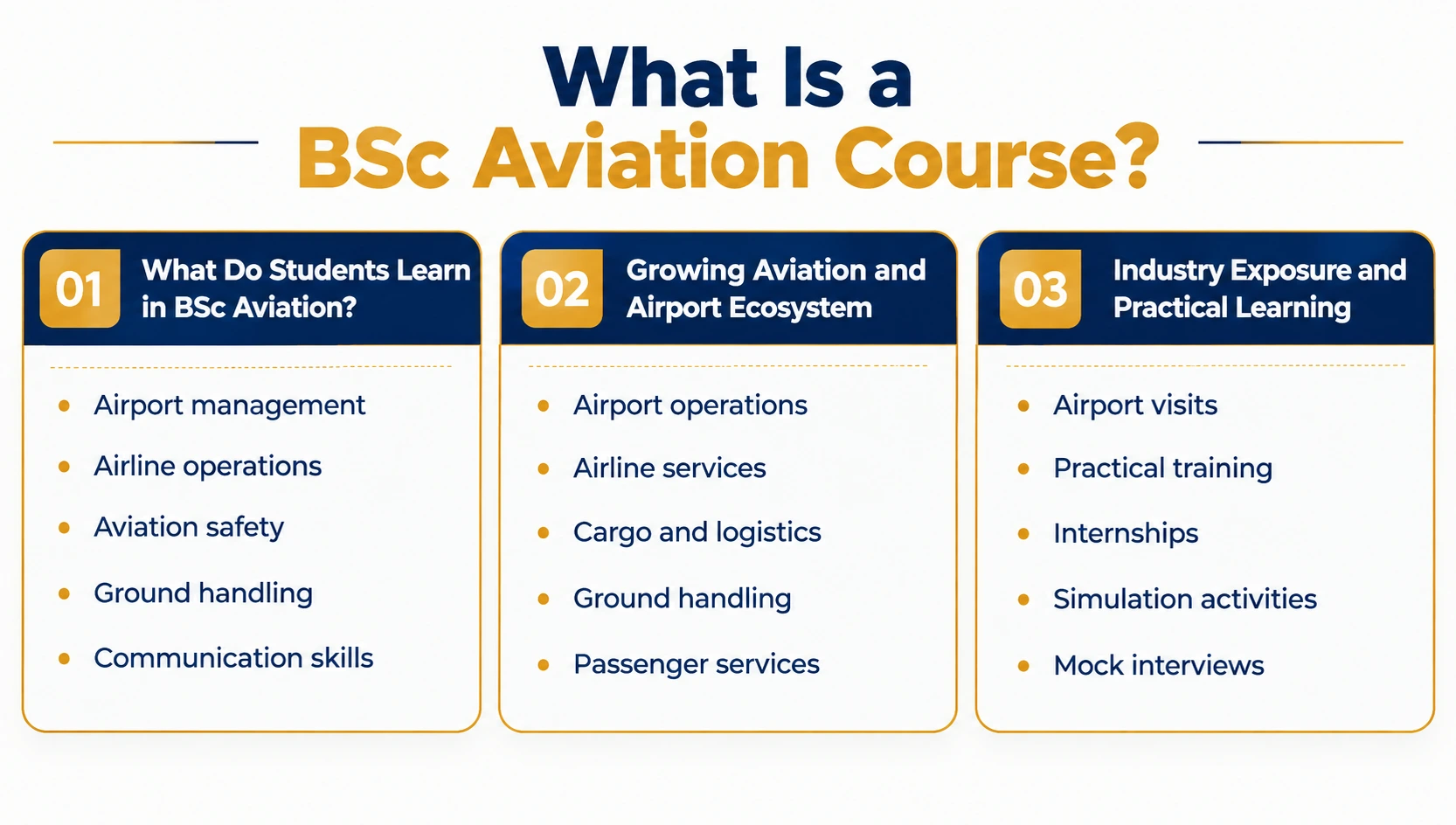
A BSc Aviation Course in Chennai is an undergraduate program that introduces students to the science, operations, management, and business side of aviation. Instead of focusing on only one airport role, the course can cover areas such as airline operations, airport management, aviation safety, passenger services, and ground handling.
The exact syllabus, eligibility, and duration depend on the university offering the degree. Aviation also remains a major and growing industry in India. IATA recorded 218.2 million passengers in India in 2025, making India the world’s fourth-largest passenger market by country.
For students, this creates a reason to look beyond the degree itself and compare practical training, industry exposure, internships, and career support before choosing a BSc Aviation Course in Chennai.
What Do Students Learn in BSc Aviation?
A BSc Aviation Course in Chennai combines aviation knowledge with operational and professional skills. Students typically study how airlines, airports, passengers, aircraft operations, and ground services work together. The exact subjects vary between universities, so students should always check the official syllabus before applying.
Common learning areas include:
- Airport Management: Understand terminal operations and passenger services.
- Airline Operations: Learn how airlines coordinate flights and daily operations.
- Aviation Safety: Understand safety procedures and risk management.
- Ground Handling: Learn baggage, ramp, passenger, and aircraft-support processes.
- Aviation Management: Explore planning, administration, and business operations.
- Communication Skills: Develop professional communication for customer-facing roles.
Example: A student might learn airport theory in class and then apply that knowledge while studying passenger check-in, baggage handling, or airport customer service procedures.
Growing Aviation and Airport Ecosystem
India’s aviation sector continues to create opportunities for students who want aviation-related careers. IATA reported that India’s domestic air passenger demand grew 5.2% in 2025, while India’s domestic passenger load factor reached 85.2%, the highest among the major domestic markets tracked in its report. This growth supports demand across more than just airline cabins.
Example: A graduate interested in customer interaction could explore airport customer-service roles, while another student could focus on ground or cargo operations.
Industry Exposure and Practical Learning
A classroom can teach aviation concepts, but practical exposure helps students understand how those concepts work in real situations. When comparing a BSc Aviation Course in Chennai, look for programs that combine academic learning with practical activities, industry visits, internships, simulations, workshops, and interview preparation.
This matters because aviation requires students to apply knowledge while communicating professionally and responding to operational situations. India’s domestic aviation market recorded 5.2% demand growth in 2025, according to IATA, highlighting the scale of activity students may prepare to enter.
Example: Instead of only studying airport check-in procedures from a textbook, students can practise a simulated passenger check-in process, handle common customer questions, and learn how staff coordinate during busy periods.
BSc Aviation Eligibility After 12th
Students planning to pursue a BSc Aviation Course in Chennai should first check the university’s academic and admission requirements. Eligibility can vary between institutions, so students should not assume that every BSc Aviation program follows the same criteria.
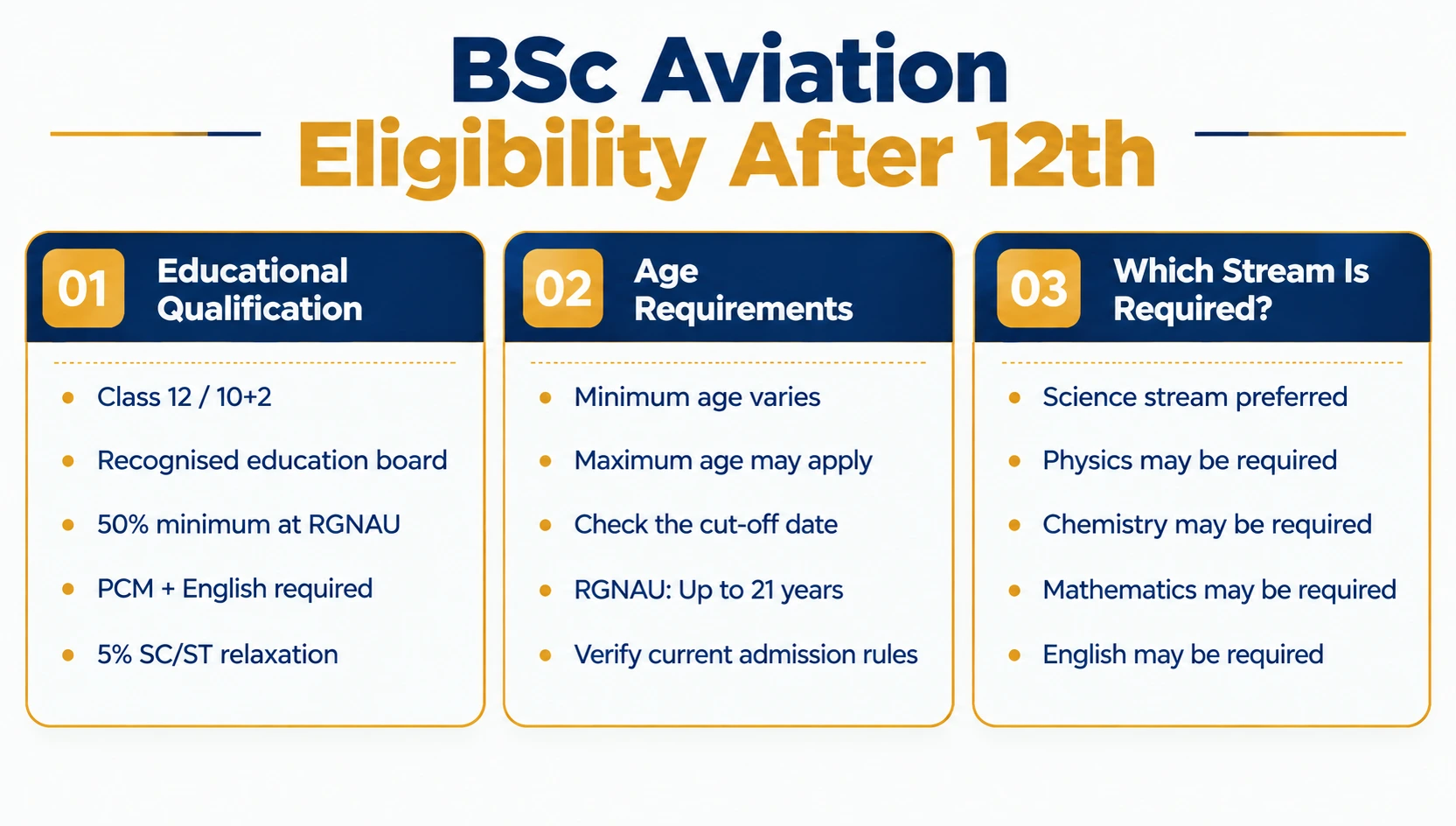
For example, RGNAU’s 2026–27 B.Sc. Aviation programme requires students to complete 10+2 with Physics, Chemistry, Mathematics and English and secure at least 50% aggregate marks. SC/ST candidates receive a 5% marks relaxation under the stated criteria. The programme also sets a maximum age of 21 years as of July 31, 2026.
Before applying, students should check the university’s latest eligibility rules, required subjects, minimum marks, age limit and entrance requirements.
Educational Qualification
For a BSc Aviation Course in Chennai, Class 12 or an equivalent 10+2 qualification forms the basic academic requirement. However, universities can specify different subjects and minimum marks.
For example, RGNAU’s 2026–27 B.Sc. Aviation admission requires 50% aggregate marks in 10+2, with Physics, Chemistry, Mathematics and English as compulsory subjects. SC/ST candidates can receive a 5% relaxation in the qualifying marks.
| Qualification | Requirement |
|---|---|
| Education | Class 12 / 10+2 or equivalent |
| Board | Recognised education board |
| Minimum Marks | 50% at RGNAU |
| Compulsory Subjects | Physics, Chemistry, Mathematics & English |
| SC/ST Relaxation | 5% marks |
| Course | 3-Year B.Sc. Aviation |
Example: A student who completes Class 12 with 55% and all four required subjects meets the stated academic threshold for RGNAU, subject to other admission conditions.
Age Requirements
Age requirements for a BSc Aviation Course in Chennai can vary between universities. Unlike the academic qualification, age limits do not follow one common rule across every aviation degree programme. Students should check the admission notification for the specific academic year before applying.
For example, RGNAU’s 2026–27 B.Sc. Aviation admission sets a maximum age of 21 years as of July 31, 2026. This shows why students should verify the cut-off date instead of assuming that every college follows the same age rule.
Before applying, check:
- Minimum age: Some institutions may specify a minimum age.
- Maximum age: Certain universities may impose an upper age limit.
- Cut-off date: The university may calculate age on a specific date.
Example: Suppose a university sets a maximum age of 21 years on July 31, 2026. A student who turns 22 before that date would not meet that particular requirement, even if the student has completed Class 12 with the required marks.
Which Stream Is Required?
The required Class 12 stream for a BSc Aviation Course in Chennai depends on the university. Some programmes accept students who complete Higher Secondary education, while others require specific Science subjects. Therefore, students should not assume that every BSc Aviation programme follows the same stream requirement.
For example, RGNAU’s 2026–27 B.Sc. Aviation programme specifically requires Physics, Chemistry, Mathematics and English in Class 12, along with a minimum 50% aggregate.
Example: A student from the Science stream with Physics and Mathematics may meet the subject requirements of a university that expects a technical background. A Commerce student may qualify for another aviation management programme but not for a BSc Aviation programme that specifically requires Science subjects.
BSc Aviation Fees in Chennai
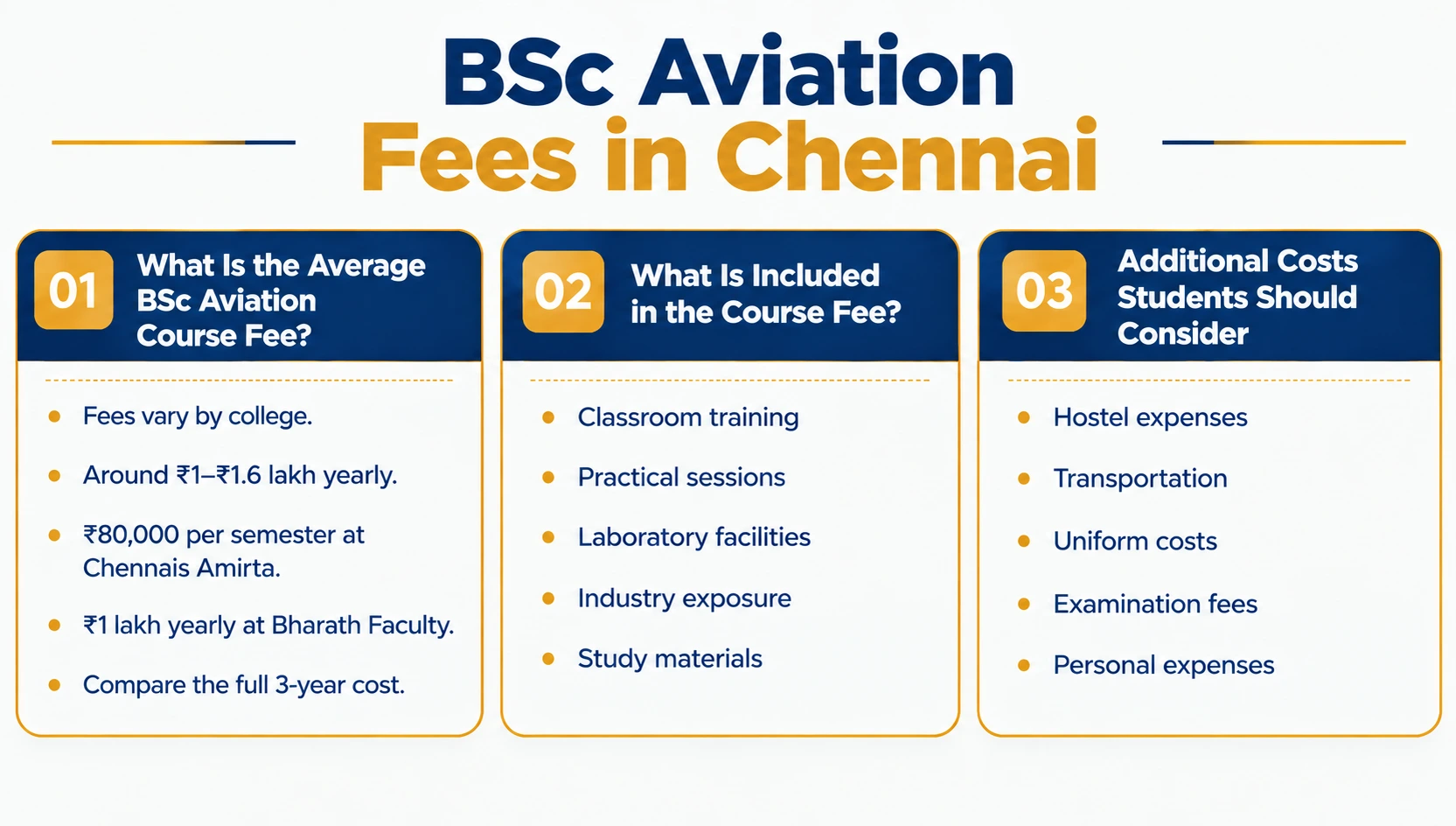
BSc Aviation fees in Chennai vary by university, syllabus, facilities, and industry exposure. For example, Chennai Amirta lists a B.Sc. Aviation programme at ₹80,000 per semester, with a typical 3-year, 6-semester structure. That equals about ₹4.8 lakh in tuition across six semesters.
Before choosing a college, compare the total course cost rather than tuition alone. Check whether the fee covers practical training, airport visits, study materials, internships, examinations, and other student services.
What Is the Average BSc Aviation Course Fee?
There is no single fixed average for an Aviation Course in Chennai because colleges use different fee structures.
Published Chennai examples show annual fees ranging from around ₹1 lakh to ₹1.50 lakh, while some institutions charge by semester. Chennais Amirta, for example, lists ₹80,000 per semester, equivalent to about ₹1.6 lakh per academic year when calculated across two semesters.
Bharath Faculty of Arts and Science lists ₹1 lakh for B.Sc. Aviation, while Bharath Institute of Higher Education and Research lists ₹1.50 lakh per year.
Example: If a college charges ₹80,000 per semester for six semesters, tuition alone comes to approximately ₹4.8 lakh.
When comparing BSc Aviation fees in Chennai, check whether the quoted amount includes practical training, examination charges, airport visits, uniforms and other compulsory expenses. A lower advertised fee may not always mean a lower final cost.
What Is Included in the Course Fee?
The course fee usually covers the academic component of a BSc Aviation programme, but the exact inclusions depend on the institution. Students should ask for a detailed fee structure before paying the admission amount.
Common inclusions may cover:
- Classroom teaching: Aviation subjects, management and operational concepts.
- Practical sessions: Training connected with aviation operations and procedures.
- Laboratory work: Applicable facilities required by the curriculum.
- Examinations: Some colleges include examination charges, while others bill them separately.
- Industry exposure: Airport visits or workshops may form part of the programme.
- Learning resources: Study materials may come under the academic fee.
Example: Chennais Amirta lists its B.Sc. Aviation Management fee at ₹80,000 per semester and highlights hands-on training as part of the programme.
Additional Costs Students Should Consider
Tuition does not always represent the complete cost of a BSc Aviation Course in Chennai. Students should budget for expenses that colleges may charge separately. Hostel, transport and personal living costs can significantly increase the total amount over three years.
Common additional expenses include:
- Hostel and accommodation: Charges vary according to room type and facilities.
- Transport: Daily travel to campus or airport training locations can add to monthly expenses.
- Uniforms: Aviation programmes may require formal uniforms or professional attire.
- Examination fees: Some institutions charge these separately.
Example: If tuition costs ₹1.5 lakh per year and a student spends ₹60,000 annually on accommodation and other expenses, the education budget can exceed ₹2.1 lakh per year.
Always request a complete fee sheet before admission. This helps you compare BSc Aviation fees in Chennai based on the total investment, rather than tuition alone.
What Training Does a BSc Aviation Student Receive?
A BSc Aviation Course in Chennai combines classroom theory with practical aviation learning. Students study aviation fundamentals, navigation, flight planning, meteorology, aircraft systems, air regulations, aviation safety and flight operations.
A current RGNAU B.Sc. Aviation programme runs for 3 years across 6 semesters and includes practical learning, simulation-based understanding, industry exposure, and internship or project work.
Students should therefore compare colleges based on more than the syllabus. Look for simulation activities, practical sessions, industry interaction, internships and project opportunities. This approach helps students connect technical concepts with real aviation operations and develop the skills required for aviation careers.
Communication and Personality Development
Communication and personality development play an important role in aviation careers, especially in passenger-facing roles. Students develop spoken English, active listening, body language, confidence, teamwork and customer-service skills. IATA highlights active listening, self-awareness, cultural awareness and clear communication as key aviation skills.
Training can include role plays, presentations, group discussions and mock interviews. For example, a student can practise handling an upset passenger, making a clear boarding announcement or answering an airline interview question confidently.
Students can also improve grooming, professional etiquette and positive body language. These skills help them communicate effectively with passengers and colleagues while maintaining professionalism in busy airport or airline environments.
Classroom Training
Classroom training builds the technical foundation for a BSc Aviation Course in Chennai. Students learn core subjects before moving into advanced aviation topics.
RGNAU’s curriculum covers 6 semesters, beginning with subjects such as Mathematics, Physics, Introduction to Aviation, Navigation, Meteorology and Air Regulations. Later semesters introduce Aircraft Systems, Flight Operations, Aviation Safety, Maintenance Management, Flight Planning and Aviation Laws.
| Training Area | Key Learning |
|---|---|
| Aviation Fundamentals | Basic aviation concepts |
| Navigation | Navigation principles and systems |
| Meteorology | Weather and aviation |
| Air Regulations | Aviation rules and laws |
| Aircraft Systems | Aircraft components and systems |
| Flight Operations | Operational procedures |
| Aviation Safety | Safety and risk management |
| Flight Planning | Planning and operational decisions |
Example: A student may study airport operations in class and then analyse how passenger flow changes during peak travel periods.
Practical Aviation Training
Practical training helps students connect classroom concepts with real aviation operations. When comparing a BSc Aviation Course in Chennai, look for programmes that provide hands-on activities, industry visits, simulations, workshops, or internships.
Students may gain exposure to:
- Airport operations: Understand terminal and passenger processes.
- Ground handling: Learn baggage, ramp, and turnaround activities.
- Customer service: Practise passenger communication and problem-solving.
- Safety procedures: Understand operational safety practices.
- Industry visits: Observe aviation activities in real environments.
Example: Instead of only reading about check-in procedures, students can practise a simulated check-in process and handle common passenger questions.
India’s domestic passenger traffic grew 5.2% in 2025, showing the scale of activity students prepare to enter.
Ready to Build Your Aviation Career?
Get practical, industry-focused aviation training and develop the communication, operational and professional skills needed for aviation careers.
Explore Aviation Training Programs at Logica Training School →
Conclusion
Choosing the Best BSc Aviation Course in Chennai is about more than comparing fees. Students should evaluate eligibility, syllabus, practical training, industry exposure, internships, communication skills and career support before making a decision.
The right aviation education can build the knowledge and confidence needed to explore opportunities across airports, airlines, ground handling and aviation operations.
Ready to start your aviation career? Explore the training programs at Logica Training School and choose a course that matches your career goals.
Start your aviation journey with the right training today!
FAQs
1. What is the best BSc Aviation Course in Chennai?
The best BSc Aviation Course in Chennai should offer a recognized degree, relevant syllabus, practical training, industry exposure, internships and career support. Compare these factors instead of choosing a college based only on fees.
2. How much does a BSc Aviation Course in Chennai cost?
BSc Aviation fees in Chennai vary by institution. Published examples range from around ₹1 lakh to ₹1.50 lakh per year, while some colleges charge by semester. Always check the complete three-year fee structure.
3. What is the eligibility for BSc Aviation after 12th?
Most programmes require Class 12 or an equivalent qualification from a recognised board. However, subject and minimum-mark requirements differ between universities. Some institutions specifically require Physics, Mathematics and other Science n management. Your career outcome also depends on skills, practical training and experience.
4. How many years is a BSc Aviation course?
A standard BSc Aviation course generally takes 3 years, divided into six semesters. Some universities may also offer a four-year honours pathway under their current academic structure.
5. Is BSc Aviation a good career option?
Yes. BSc Aviation can prepare students for careers across airport operations, airline support, ground handling, passenger services, cargo and aviation.
6. What jobs can I get after BSc Aviation?
Graduates can explore roles such as airport operations executive, airline operations executive, ground operations professional, airport customer-service executive, cargo operations executive and aviation management professional.
7. Can I join aviation after completing 12th?
Yes. Students can enter aviation after Class 12 through degree programmes, diplomas and specialised aviation courses. Check each institution’s eligibility requirements before applying.
8. Is BSc Aviation better than a diploma?
A BSc Aviation degree provides a broader undergraduate qualification, while a diploma can offer shorter, focused vocational training. The better option depends on your career goal, budget, preferred study duration and eligibility.
9. Does BSc Aviation guarantee a job?
No course should automatically be treated as a guaranteed job. Students should evaluate placement support, internships, industry exposure, faculty experience and alumni outcomes before choosing a BSc Aviation Course in Chennai.
10. What skills are important for an aviation career?
Communication, English proficiency, customer service, teamwork, problem-solving, professional grooming, computer skills and operational awareness can help students build stronger aviation careers.