
Introduction
Choosing the right course after Class 12 can feel difficult, especially if you want a career connected to airports, airlines, or aviation operations. BSc Aviation after 12th offers a structured pathway into this growing industry, but students often have questions about eligibility, subjects, fees, course duration, and career opportunities. The demand for aviation professionals continues to rise: India recorded 420.09 million domestic and international air passengers in FY26, according to IBEF, while the sector supports over 7.7 million jobs, according to the Government of India. This guide explains BSc Aviation after 12th requirements, course details, expected fees, and career options, helping students make an informed decision about their aviation education and future.
Can I Pursue BSc Aviation After 12th?
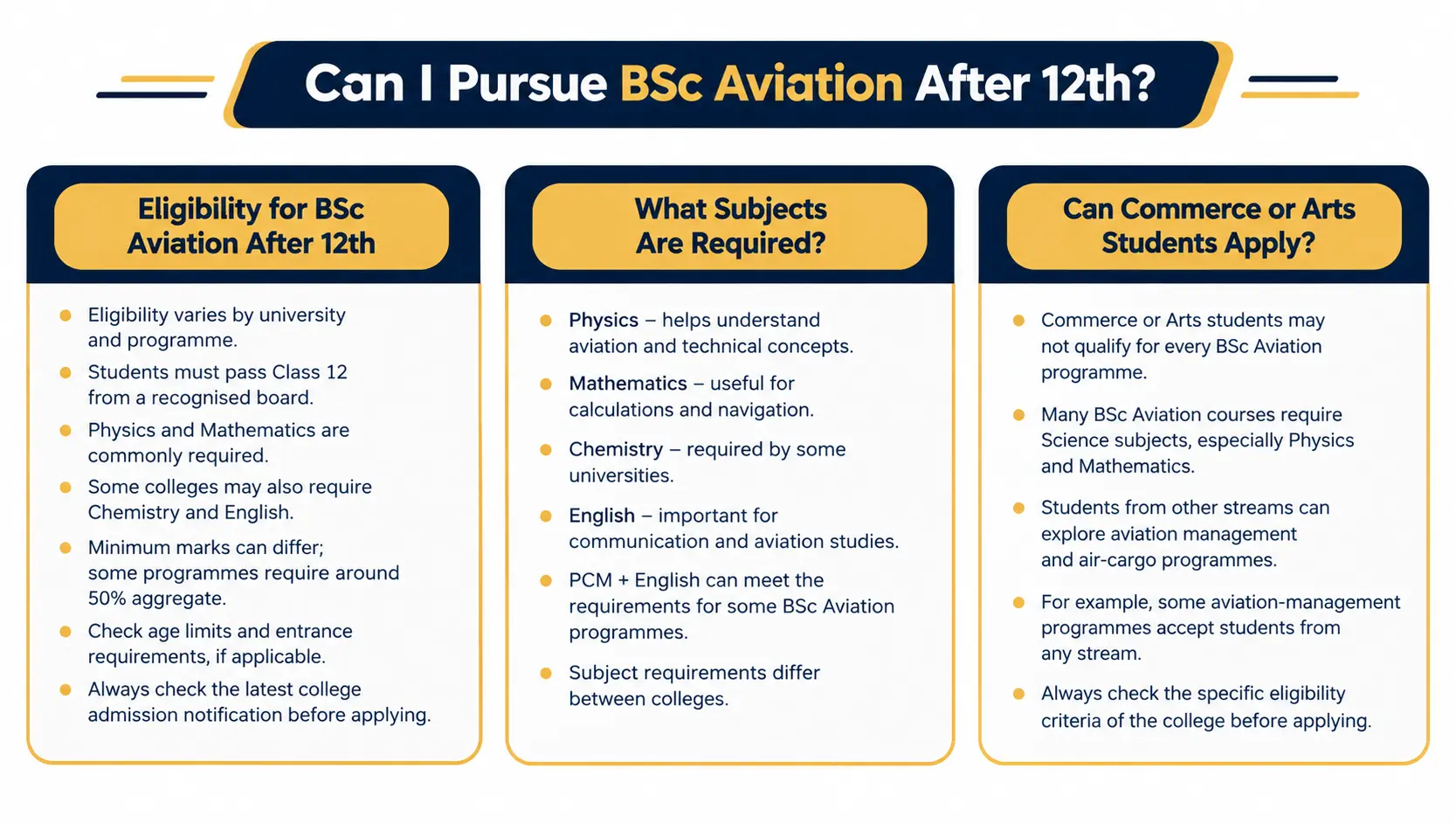
Yes, you can pursue BSc Aviation after 12th if you meet the eligibility requirements of the university or college you choose. Most institutions require students to complete Class 12 from a recogzised board, while specific subject and minimum-mark requirements vary. For example, Rajiv Gandhi National Aviation University’s 2026–27 B.Sc. Aviation admission requires 10+2 with Physics, Chemistry, Mathematics and English, along with at least 50% aggregate marks. The course usually runs for 3 years or 6 semesters, giving students a foundation in aviation theory, operations, safety and related areas. Before applying, always check the latest eligibility rules published by your chosen institution.
Eligibility for BSc Aviation After 12th
The eligibility for BSc Aviation after 12th depends on the university and programmer structure. Students should check the latest admission notification instead of assuming that every college follows the same criteria. For instance, Rajiv Gandhi National Aviation University currently requires 50% aggregate marks in 10+2 with Physics, Chemistry, Mathematics and English. Some other institutions use different combinations. The University of Mumbai, for example, specifies English, Physics and Mathematics for its B.Sc. Aviation eligibility.
Before applying, check these key requirements:
- Pass Class 12 from a recognised board.
- Check the required subjects carefully.
- Verify the minimum percentage.
- Check age restrictions, if applicable.
- Review entrance-test or admission requirements.
What Subjects Are Required for BSc Aviation?
The required subjects for BSc Aviation after 12th can differ between institutions, so students should verify the current admission notice before applying. Several aviation programms give strong importance to Physics and Mathematics. For example, RGNAU’s 2026–27 B.Sc. Aviation programmer requires Physics, Chemistry, Mathematics and English. IGRUA also evaluates Physics, Mathematics and English for its B.Sc. Aviation selection.
Commonly required or preferred subjects include:
- Physics – builds an understanding of aviation-related scientific concepts.
- Mathematics – supports navigation and technical calculations.
- Chemistry – required by some universities.
- English – supports communication and aviation-related learning.
For example, a student with Physics, Chemistry, Mathematics and English in Class 12 can meet the subject requirements for RGNAU’s current programme. If you are planning to pursue BSc Aviation after 12th, always compare the subjects listed by your preferred college before submitting an application.
Can Commerce or Arts Students Apply for BSc Aviation?
Commerce or Arts students may find aviation-related degree options, but they should not assume that every BSc Aviation after 12th programme accepts all streams. Many B.Sc. Aviation programmes require or prefer Science subjects such as Physics and Mathematics. For example, RGNAU’s 2026–27 B.Sc. Aviation admission requires Physics, Chemistry, Mathematics and English in Class 12.
However, students exploring BSc Aviation after 12th can also consider other aviation education pathways based on their academic background. For example, RGNAU lists a Bachelor of Management Studies in Aviation Services and Air Cargo through CUET, where candidates with any stream and at least 50% aggregate can apply.
Example: Students planning BSc Aviation after 12th can choose programmes based on their academic background. A Science student with PCM can target a B.Sc. Aviation programme requiring technical subjects, while a Commerce student can explore aviation-management or air-cargo programmes that accept multiple streams. Always check the exact eligibility criteria before applying.
BSc Aviation Fees in India
The cost of a BSc Aviation after 12th varies significantly by college, university, location, and training facilities. Current official fee structures show this difference clearly. For example, RGNAU lists total academic fees of about ₹4.48 lakh for male students and ₹4.12 lakh for female students across six semesters for 2026–27, excluding hostel costs. IGRUA’s published structure also lists ₹4.48 lakh for male candidates and ₹4.12 lakh for female candidates in academic fees. Therefore, students should compare the complete cost rather than focusing only on tuition fees.
What Are the Fees for BSc Aviation?
There is no single fixed fee for a BSc Aviation after 12th because institutions follow different fee structures. For example, the University of Mumbai’s published B.Sc. Aviation structure lists tuition at ₹25,000 per semester, while additional university, examination, library, and other charges apply separately. Another example, IAAS lists its three-year B.Sc. Aviation programme at ₹66,000 per year.
Students should check these costs before choosing a college:
- Tuition fee
- Admission or enrolment fee
- Examination charges
- Library and laboratory fees
- Insurance or student welfare charges
- Refundable caution deposits
- Hostel and mess expenses
Always check the latest official fee notification because institutions can revise fees between academic years.
Other Costs Students Should Consider
Tuition represents only one part of the total cost of a BSc Aviation after 12th. Students should also budget for accommodation, meals, transportation, study materials, insurance, examinations, and other institutional charges. For example, RGNAU lists ₹78,000 per year for hostel-related charges in its 2026–27 fee structure, covering hostel and mess components along with other listed charges.
| Expense | What to Check |
| Tuition | Semester or annual fee |
| Hostel | Room and accommodation charges |
| Mess | Food and meal expenses |
| Transport | College or airport travel |
| Examination | Semester examination charges |
| Study materials | Books, equipment and supplies |
| Insurance | Student medical coverage |
| Deposits | Refundable caution deposits |
Planning these expenses early helps families estimate the actual three-year education budget, rather than looking only at tuition.
How to Compare BSc Aviation Colleges Based on Fees
When comparing colleges for BSc Aviation after 12th, look beyond the advertised tuition fee. A lower fee does not automatically mean better value. Compare the total programme cost, facilities, training opportunities, faculty, internships, and placement support. For example, one college may charge ₹2 lakh per year but offer hostel separately, while another may include some accommodation or academic services in its package. RGNAU, for instance, separately identifies academic and hostel costs in its 2026–27 structure.
Use this simple comparison:
- College A: ₹3 lakh academic cost + ₹1 lakh accommodation
- College B: ₹3.5 lakh academic cost + ₹60,000 accommodation
- College C: ₹4 lakh academic cost with stronger practical facilities
Compare the total cost and career value, not just the headline fee. Also check whether the institution offers scholarships or fee concessions before making your final decision.
BSc Aviation Syllabus and Subjects
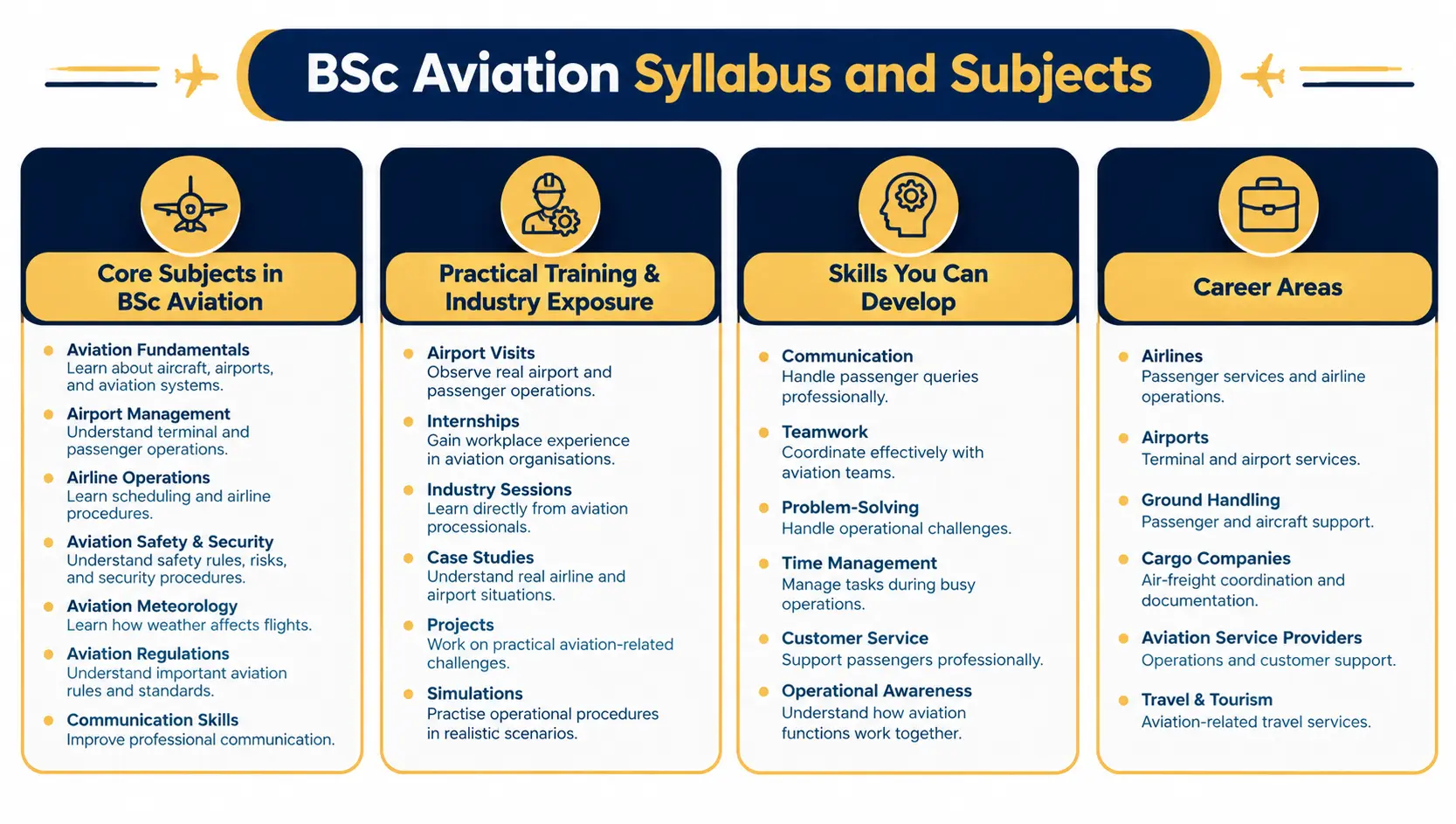
The BSc Aviation syllabus gives students a structured introduction to aviation operations, airport management, safety, airline services, and related areas. Most undergraduate programmes run for 3 years or 6 semesters, although the exact structure varies by institution. Students typically combine classroom learning with practical activities, projects, and industry exposure. The syllabus helps learners understand how airports and airlines operate while developing professional skills for aviation careers. Core areas may include aviation fundamentals, airport operations, aviation safety, airline management, aviation security, meteorology, and communication. Before admission, students should check the latest syllabus published by their chosen university because subject names, semester structures, and practical components can differ.
Core Subjects in BSc Aviation
The BSc Aviation syllabus generally covers subjects that help students understand both technical concepts and aviation operations. Universities can structure these subjects differently, so students should check the current curriculum before admission. Common areas include:
- Aviation Fundamentals: Introduces aircraft, airports, and aviation systems.
- Airport Management: Explains terminal operations, passenger services, and airport administration.
- Airline Operations: Covers scheduling, coordination, and operational procedures.
- Aviation Safety: Builds awareness of safety procedures and risk management.
- Aviation Security: Introduces airport security systems and procedures.
- Aviation Meteorology: Explains how weather affects aviation activities.
- Aviation Regulations: Introduces important aviation rules and standards.
- Communication Skills: Develops professional communication for aviation workplaces.
Together, these subjects give students a broad foundation for entry-level aviation roles.
Practical Training and Industry Exposure
A strong BSc Aviation syllabus should connect classroom concepts with practical learning. Industry exposure helps students understand how airports, airlines, and aviation service organisations operate in real-world situations. Depending on the institution, students may participate in internships, airport visits, simulations, projects, and industry interactions. These activities can make technical concepts easier to understand and help students build workplace confidence.
Practical learning may include:
- Airport visits to observe passenger and terminal operations.
- Internships with aviation or related service organisations.
- Industry sessions with aviation professionals.
- Case studies covering airport and airline operations.
- Project work focused on real aviation challenges.
- Simulation activities that demonstrate operational procedures.
Students should compare colleges based on the quality and depth of practical exposure they provide.
Skills You Can Develop During the Course
The BSc Aviation syllabus can help students develop practical and professional skills that employers value. Aviation workplaces require employees to communicate clearly, follow procedures, work with teams, and respond calmly to operational challenges. For example, a student working on an airport-management project may learn how to coordinate passenger services, analyse operational issues, and communicate solutions to a team.
Key skills can include:
- Communication: Handling passenger queries clearly and professionally.
- Teamwork: Coordinating with colleagues during airport operations.
- Problem-solving: Finding solutions when operational issues arise.
- Time management: Prioritising tasks during busy airport schedules.
- Customer service: Supporting passengers with patience and professionalism.
- Operational awareness: Understanding how different aviation functions connect.
These skills can help graduates prepare for roles across airports, airlines, ground handling, and aviation support services.
For example:
- Airlines: Passenger service, airline operations, and administration.
- Airports: Terminal operations and airport services.
- Ground-handling companies: Passenger and aircraft support.
- Cargo companies: Air-freight coordination and documentation.
- Aviation service providers: Operational and customer-support functions.
- Travel and tourism companies: Aviation-linked travel services.
For students considering BSc Aviation after 12th, the course can open up different career paths based on individual interests and skills. For instance, a graduate interested in logistics could explore air-cargo operations, while someone who enjoys interacting with passengers could pursue airport customer-service roles.
Career Opportunities After BSc Aviation
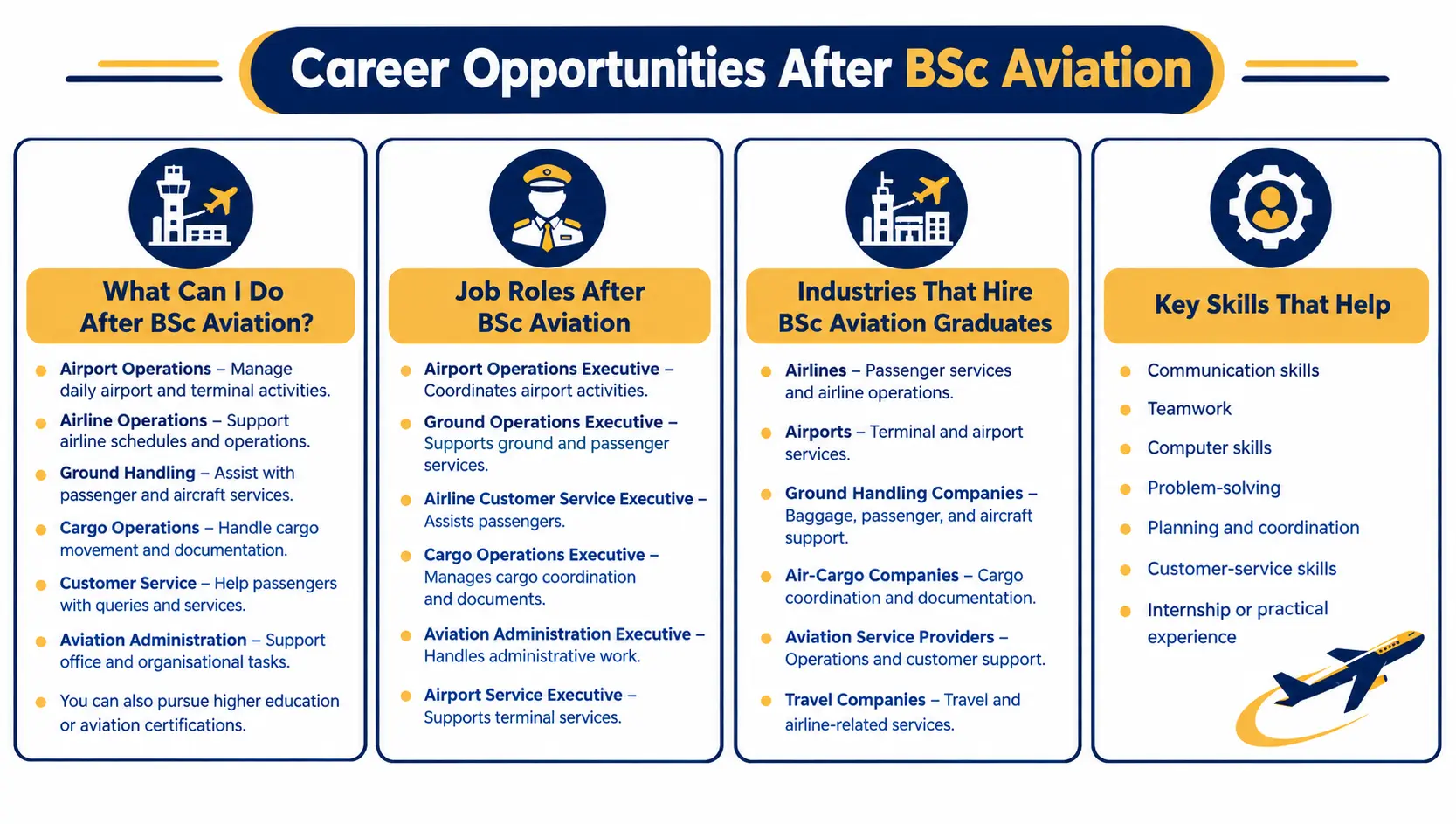
A BSc Aviation after 12th can lead to diverse career opportunities across airports, airlines, ground handling, cargo, and aviation support services. India’s aviation network has expanded significantly, with the country recording 157 operational airports in 2024, according to the Ministry of Civil Aviation. This growth creates opportunities for graduates with strong communication, coordination, and operational skills. You can explore roles in airport operations, airline services, passenger handling, cargo management, and administration. Your career progression can depend on your qualifications, practical experience, location, employer, and additional certifications. Internships and industry exposure can also strengthen your profile and help you understand which aviation career path suits your interests and skills.
What Can I Do After BSc Aviation?
After completing BSc Aviation after 12th, you can explore several career paths within the aviation industry. The degree provides knowledge of aviation operations, airport services, safety, management, and customer handling. Your choice can depend on your interests and strengths.
You can consider:
- Airport Operations: Coordinate daily terminal and operational activities.
- Airline Operations: Support airline schedules and operational coordination.
- Ground Handling: Assist with passenger and aircraft-related ground services.
- Cargo Operations: Manage air-cargo documentation and coordination.
- Customer Service: Help passengers with queries and service requirements.
- Aviation Administration: Support administrative and organisational activities.
After completing BSc Aviation after 12th, graduates can explore different career paths based on their interests and skills. For example, a graduate who enjoys interacting with people may choose passenger services, while someone who prefers planning and coordination may pursue airport operations. You can also pursue postgraduate education or specialised aviation certifications to expand your career options.
Job Roles After BSc Aviation
A BSc Aviation after 12th can help graduates prepare for entry-level roles in airport, airline, cargo, and aviation-support operations. Employers may use different job titles for similar responsibilities, so always review the specific job description before applying. Strong communication, computer skills, teamwork, and internship experience can improve your employability.
| Job Role | Key Responsibilities |
| Airport Operations Executive | Coordinates daily airport activities |
| Ground Operations Executive | Supports passenger and ground services |
| Airline Customer Service Executive | Assists passengers and handles queries |
| Cargo Operations Executive | Coordinates cargo movement and documents |
| Aviation Administration Executive | Handles administrative support |
| Airport Service Executive | Supports terminal and passenger services |
After completing BSc Aviation after 12th, graduates can choose roles that match their strengths and career interests. For example, a graduate with excellent communication skills may suit customer-service roles, while someone who enjoys organisation and problem-solving may prefer operations. Gaining relevant experience can help you progress toward supervisory and management positions.
Which Industries Hire BSc Aviation Graduates?
Students completing BSc Aviation after 12th can explore opportunities across several aviation-related industries. Airlines and airports offer well-known career paths, but graduates can also consider ground handling, air cargo, aviation services, and travel-related organisations. India’s aviation sector includes airlines, airports, cargo operators, ground-handling companies, and other aviation service providers.
Examples include:
- Airlines: Passenger services, airline operations, and administration.
- Airports: Terminal operations and airport service roles.
- Ground-handling companies: Passenger, baggage, and aircraft support.
- Air-cargo companies: Cargo coordination and documentation.
- Aviation service providers: Operational and customer-support positions.
- Travel companies: Airline and travel-service coordination.
After completing BSc Aviation after 12th, graduate interested in logistics could explore air-cargo operations, while someone who enjoys customer interaction could pursue airport passenger services. This variety allows graduates to choose roles that match their skills and long-term career goals. If you want to develop industry-relevant aviation skills and prepare for opportunities across these sectors, The Logica Aviation Academy in Chennai can help you take the next step. Explore aviation training programs at The Logica Aviation Academy
Conclusion
Choosing the right aviation course after Class 12 can shape your future career direction. BSc Aviation after 12th offers students an opportunity to build knowledge in aviation operations, airport services, airline management, safety, and related areas. Before applying, students should carefully compare eligibility requirements, course duration, fees, syllabus, practical exposure, and career opportunities offered by different institutions.
Pursuing BSc Aviation after 12th can help students build a foundation for a career in the aviation industry. A successful aviation career also depends on developing communication, teamwork, customer-service, and operational skills alongside academic knowledge. If you are ready to take the next step, The Logica Aviation Academy in Chennai can help you explore aviation-focused training and develop skills relevant to the industry. Explore The Logica Aviation Academy and start your journey toward a rewarding aviation career today.
Frequently Asked Questions
1. Can I pursue BSc Aviation after 12th?
Yes, eligible students can pursue BSc Aviation after completing Class 12.
2. What is the eligibility for BSc Aviation?
Students generally need to complete Class 12 with the required subjects and marks.
3. What subjects are required for BSc Aviation?
Physics and Mathematics are commonly required, while requirements vary by college.
4. How long is a BSc Aviation course?
A BSc Aviation course typically takes 3 years or six semesters.
5. What are the fees for BSc Aviation?
Fees vary depending on the college, location, facilities, and course structure.
6. What is included in the BSc Aviation syllabus?
It can include aviation operations, airport management, safety, security, and communication.
7. What can I do after BSc Aviation?
Graduates can explore careers in airports, airlines, cargo, ground handling, and aviation services.
8. What are the career opportunities after BSc Aviation?
Common opportunities include airport operations, airline services, cargo operations, and aviation administration.
9. What is the salary after BSc Aviation?
Salary depends on the job role, employer, location, skills, and experience.
10. Is BSc Aviation a good career choice?
Yes, it can be a good choice for students interested in aviation operations and related careers.