
The aviation industry is expanding faster than the talent pipeline can keep up – and that’s creating a serious gap. India is already the third-largest domestic aviation market globally, handling nearly 197 million passengers in 2024-25, with traffic growing up to 14-15% year-on-year. At the same time, the sector faces a 37-48% manpower shortage across key aviation bodies.
This imbalance leads to operational delays, safety risks, and rising demand for skilled professionals – especially flight dispatchers who manage flight planning and real-time decision-making. A Diploma Course in Flight Dispatching directly addresses this gap by equipping students with critical skills in navigation, meteorology, and airline operations. If you’re looking for a fast-track entry into aviation without becoming a pilot, this course offers a practical, high-demand career path with strong long-term growth.
What is a Diploma Course in Flight Dispatching?
A Diploma Course in Flight Dispatching is a specialized aviation program that trains you to plan, monitor, and manage flights from the ground. While pilots fly the aircraft, flight dispatchers ensure every flight operates safely, efficiently, and on schedule. You become the brain behind the operation – handling route planning, weather analysis, fuel calculation, and regulatory compliance.
This course typically lasts 6 months to 1 year and combines classroom learning with practical simulations. You study core aviation subjects such as:
- Meteorology (weather patterns and impact on flights)
- Air Navigation and Flight Planning
- Aviation Regulations (DGCA guidelines)
- Aircraft Performance and Load Control
For example, before a flight departs from Chennai to Delhi, a dispatcher calculates the best route, fuel requirement, and alternate airports in case of emergencies. Airlines rely heavily on dispatchers to reduce delays and improve operational efficiency.
With India’s aviation sector projected to handle over 300 million passengers by 2030, the demand for trained dispatchers continues to grow. This diploma acts as a fast-track entry into airline operations, especially for students who want an aviation career without becoming a pilot.
Definition and Role of a Flight Dispatcher
A flight dispatcher plays a critical role in airline operations by planning and overseeing flights before and during their journey. You work closely with pilots and airline teams to ensure every flight meets safety, efficiency, and regulatory standards.
Instead of sitting in the cockpit, you operate from a control center and make data-driven decisions that directly impact flight safety.
Key Responsibilities of a Flight Dispatcher
- Plan the most efficient flight routes
- Analyze weather conditions and avoid hazards
- Calculate fuel requirements and payload limits
- Monitor flights in real time and suggest route changes
- Coordinate with pilots, ATC, and ground staff
- Ensure compliance with aviation regulations
Real-Life Example
Imagine a flight from Mumbai to Dubai facing unexpected turbulence. A dispatcher quickly analyzes weather data and suggests an alternate route, helping the pilot avoid risk and maintain passenger safety.
Why This Role Matters
- Dispatchers share legal responsibility for flight safety with pilots
- Airlines depend on them to reduce delays and fuel costs
- They improve overall operational efficiency
Definition and Role of a Flight Dispatcher — Detailed Breakdown
To understand the role better, here’s a structured breakdown of what a flight dispatcher does on a daily basis:
Core Functions Table
| Function | What You Do | Example |
|---|---|---|
| Flight Planning | Design routes and calculate flight time | Choose shortest route Chennai-Delhi |
| Weather Analysis | Study weather patterns and forecasts | Avoid storms over the Bay of Bengal |
| Fuel Management | Calculate exact fuel requirements | Add extra fuel for alternate airport |
| Safety Compliance | Follow aviation authority regulations | Ensure DGCA guidelines are met |
| Real-Time Monitoring | Track flights and update pilots during journey | Suggest rerouting during turbulence |
Daily Workflow Snapshot
- Review flight schedules
- Prepare dispatch release documents
- Brief pilots before departure
- Monitor flights using tracking systems
- Handle emergencies or unexpected changes
Key Skills You Use
- Analytical thinking
- Quick decision-making
- Strong communication
- Attention to detail
Why Choose a Career in Flight Dispatching?
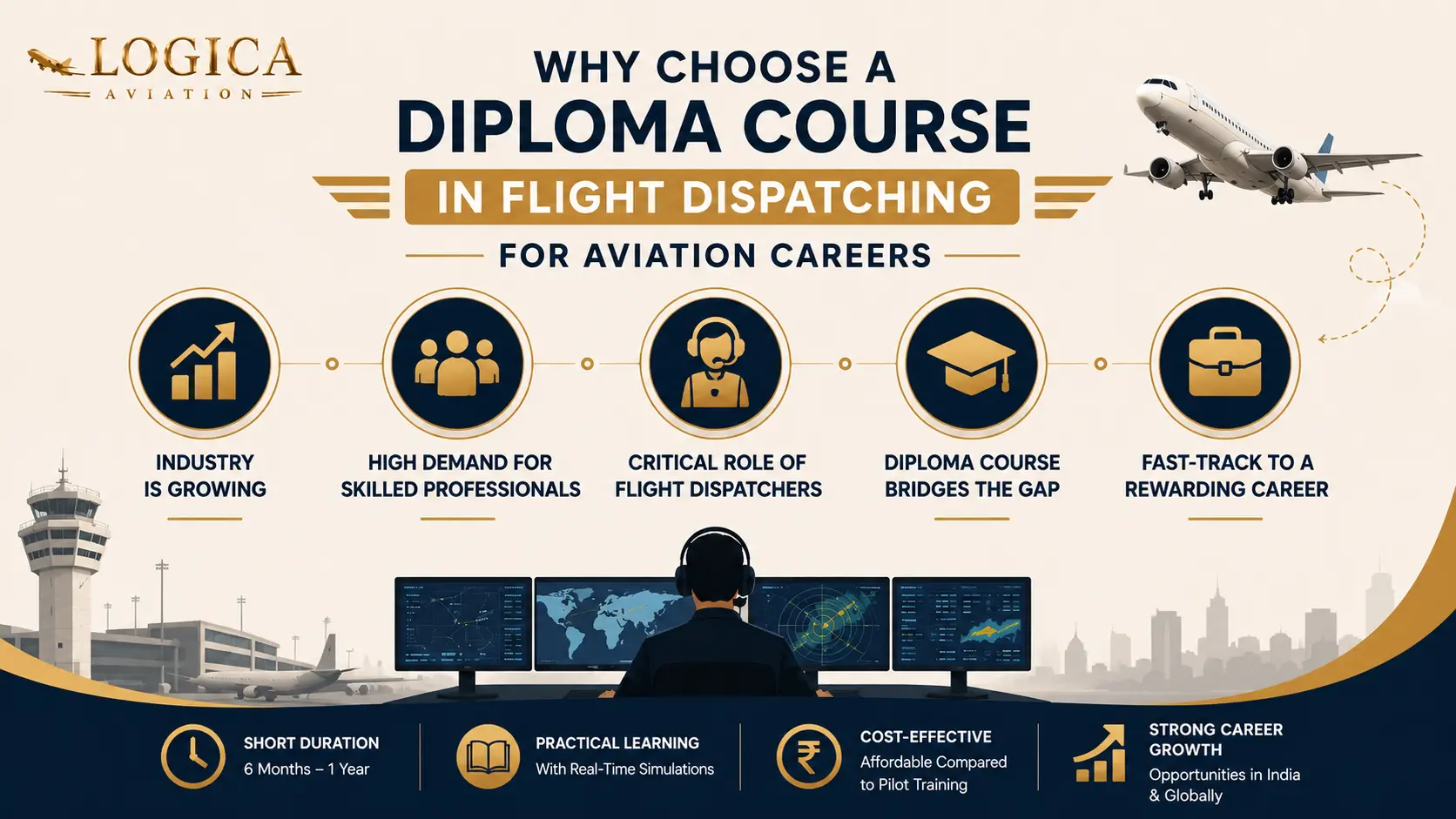
If you want a high-impact aviation career without spending years and crores on pilot training, flight dispatching offers a smart alternative. You step into a role that directly influences flight safety, efficiency, and on-time performance – right from the ground.
India’s aviation sector continues to surge, with passenger traffic expected to cross 300 million by 2030. Airlines are expanding fleets, adding routes, and hiring skilled professionals to manage operations. That’s where flight dispatchers come in.
Why This Career Stands Out
- Faster entry into aviation
You can start your career within 6-12 months of training. - High demand across airlines
Every commercial flight requires dispatch support. - Cost-effective training
Compared to pilot training, this course costs significantly less. - Stable and structured career path
You can grow into roles like Operations Manager or Chief Dispatcher.
Example
A fresh graduate joins an airline as a Flight Operations Officer. Within a few years, they gain experience, handle international routes, and move into senior operations roles – all without flying the aircraft.
In short, flight dispatching gives you a front-row seat in aviation operations, strong career growth, and global exposure – without the heavy financial burden.
Growing Demand in the Aviation Industry
The aviation industry is expanding rapidly, and the demand for skilled flight dispatchers is rising alongside it. Airlines need trained professionals who can manage complex flight operations efficiently.
India has already become one of the fastest-growing aviation markets, with double-digit growth in passenger traffic. New airports, increased fleet sizes, and rising domestic travel continue to drive hiring.
Key Growth Drivers
- Rapid expansion of low-cost airlines
- Increase in domestic and international routes
- Government focus on regional connectivity (UDAN scheme)
- Rising middle-class travel demand
Demand Snapshot
| Factor | Impact on Jobs |
|---|---|
| Fleet Expansion | More flights require more dispatchers |
| New Airports | Increased operational complexity |
| International Routes | Need for advanced flight planning skills |
| 24/7 Airline Operations | Continuous demand for dispatch teams |
Why This Matters for You
- Airlines actively recruit trained dispatchers
- Job openings grow as aviation scales up
- Skilled professionals enjoy better job security
Example
When an airline adds 20 new aircraft to its fleet, it also needs a larger operations team. That directly increases demand for dispatchers who can plan and monitor those additional flights.
High Responsibility and Global Career Opportunities
Flight dispatching is not just another job – it’s a high-responsibility role where your decisions directly affect flight safety. Airlines trust you to make critical calls before and during flights.
You share operational responsibility with the pilot, which makes this career both challenging and rewarding.
What Makes This Role High-Impact
- You ensure passenger safety through accurate planning
- You handle real-time decision-making during emergencies
- You coordinate with multiple aviation teams globally
- You help airlines save fuel and reduce delays
Career Opportunities Worldwide
| Region | Opportunities Available |
|---|---|
| India | Airlines, charter services, cargo operators |
| Middle East | High-paying airline dispatcher roles |
| Europe | Advanced aviation operations positions |
| Southeast Asia | Growing aviation hubs and new airlines |
Global Career Advantages
- International job mobility
- Exposure to global aviation standards
- Opportunities in major airline hubs
Example
A dispatcher trained in India can later apply for roles in the Middle East, where airlines operate large fleets and offer competitive salaries. With experience, professionals often move into senior international operations roles.
Challenges in the Flight Dispatching Career
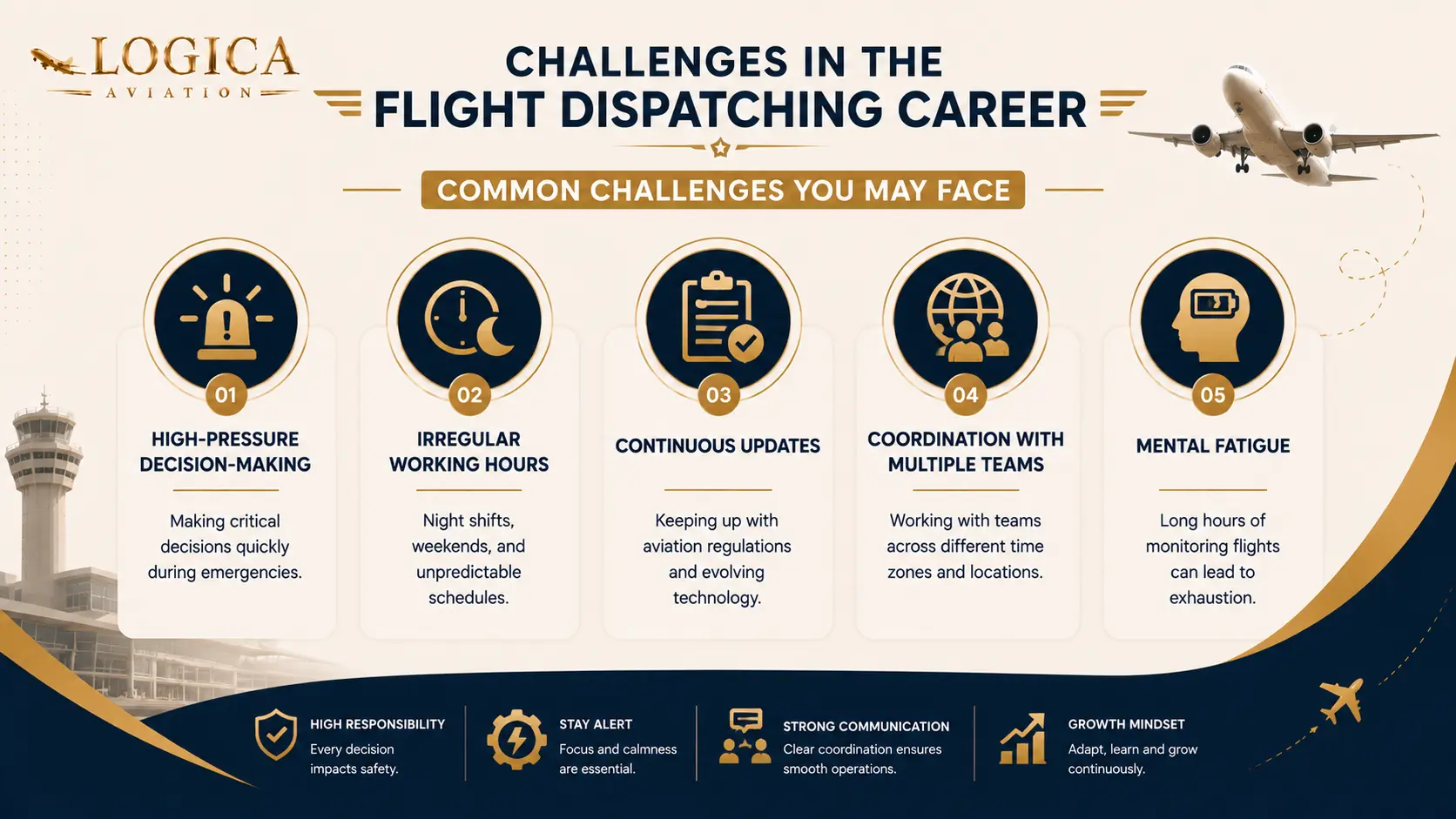
A career in flight dispatching offers strong growth and global exposure, but it also comes with real challenges. You operate in a high-stakes environment where even small mistakes can impact safety, schedules, and airline costs. That responsibility demands focus, discipline, and continuous learning.
One major challenge involves handling real-time decisions under pressure. Flights don’t always go as planned – weather changes, technical issues, or airspace restrictions can disrupt operations. Dispatchers must quickly analyze data and suggest the safest alternative.
Common Challenges You May Face
- High-pressure decision-making during emergencies
- Irregular working hours, including night shifts and weekends
- Continuous updates in aviation regulations and technology
- Coordination with multiple teams across different time zones
- Mental fatigue due to long hours of monitoring flights
Example
Imagine managing multiple flights during monsoon season in India. Sudden storms force route changes, delays, and fuel recalculations. You must act quickly while ensuring safety and compliance.
Despite these challenges, many professionals enjoy the role because it keeps them engaged, sharp, and directly connected to aviation operations. If you handle pressure well, this career can feel both exciting and rewarding.
High Responsibility and Pressure
Flight dispatchers carry significant responsibility. Every decision you make affects passenger safety, fuel efficiency, and airline schedules. You don’t just support flights – you actively influence their success.
You must stay alert, process complex data quickly, and communicate clearly with pilots and airline teams.
Why the Role Feels Intense
- You share operational responsibility with pilots
- You must make quick decisions with limited time
- You handle unexpected disruptions like weather or delays
- You monitor multiple flights simultaneously
Situations That Create Pressure
- Sudden weather changes (e.g., thunderstorms, fog)
- Technical issues requiring alternate routes
- Air traffic congestion causing delays
- Emergency diversions
Real-Life Example
A dispatcher monitors a flight heading toward heavy turbulence. Instead of waiting, they analyze weather radar and suggest a safer route. That quick decision helps avoid risk and ensures passenger safety.
Key Skills to Handle Pressure
- Strong analytical thinking
- Calm decision-making
- Clear communication
- Attention to detail
In this role, pressure becomes part of your daily routine. However, with training and experience, you learn to stay calm and make confident decisions.
High Responsibility and Pressure — Detailed Breakdown
To understand the intensity of this role, let’s break down the responsibilities and pressure points in a structured way:
Pressure vs Responsibility Table
| Situation | Your Responsibility | Pressure Level | Example |
|---|---|---|---|
| Flight Planning | Choose safest and most efficient route | Medium | Avoid restricted airspace |
| Weather Disruptions | Reroute flights instantly | High | Divert flight due to cyclone |
| Fuel Management | Calculate precise fuel requirements | High | Add extra fuel for alternate airport |
| Real-Time Monitoring | Track multiple flights simultaneously | High | Manage 5-10 flights during peak hours |
| Emergency Situations | Support pilots with quick decisions | Very High | Suggest emergency landing airport |
Daily Pressure Points
- Managing multiple flights at once
- Making time-sensitive decisions
- Communicating with pilots and control teams
- Ensuring zero compromise on safety
Example
During peak travel seasons, airlines operate back-to-back flights. A dispatcher may handle several aircraft at the same time. One delay or miscalculation can impact multiple schedules, increasing the pressure to stay precise.
In summary, this career demands focus, speed, and accountability – but it also builds strong decision-making skills that set you apart in the aviation industry.
Skills You Will Learn in Flight Dispatching Course
A Diploma in Flight Dispatching equips you with a powerful mix of technical expertise and real-world decision-making skills. Airlines expect dispatchers to think fast, act smart, and communicate clearly – and this course prepares you for exactly that.
You won’t just study theory. You will apply concepts through simulations, case studies, and real-flight scenarios. For example, you might plan a Chennai-Delhi route while considering weather, fuel load, and alternate airports – all in one exercise.
Key Skill Areas You Will Develop
- Flight planning and route optimization
- Weather analysis and risk assessment
- Fuel calculation and load management
- Aviation regulation compliance (DGCA standards)
- Real-time flight monitoring and coordination
Why These Skills Matter
- Airlines operate thousands of flights daily, and each one needs accurate planning
- A small miscalculation can increase fuel costs or cause delays
- Skilled dispatchers help airlines save time, reduce risks, and improve efficiency
Example
During training, you may simulate a scenario where bad weather affects a scheduled flight. You must quickly adjust the route, calculate extra fuel, and suggest alternatives – just like in real airline operations.
In short, this course builds job-ready skills that airlines actively look for in flight operations teams.
Technical Skills
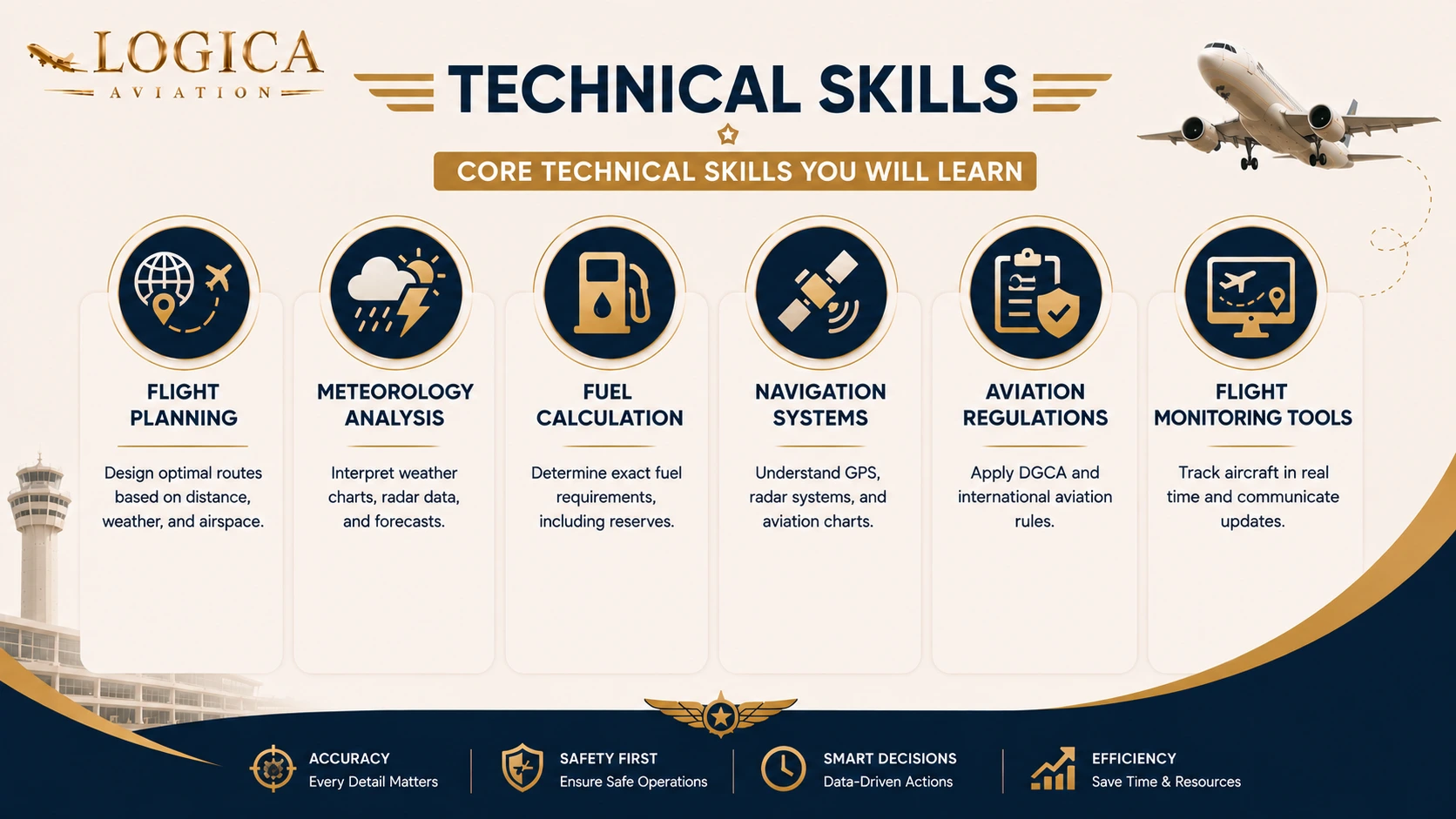
Technical skills form the backbone of a flight dispatcher’s role. You learn how to analyze data, use aviation tools, and make precise calculations that directly impact flight safety and efficiency.
Core Technical Skills You Will Learn
- Flight Planning
Design optimal routes based on distance, weather, and airspace.
Example: Choosing a shorter route to reduce fuel consumption. - Meteorology Analysis
Interpret weather charts, radar data, and forecasts.
Example: Avoiding turbulence by rerouting a flight. - Fuel Calculation
Determine exact fuel requirements, including reserves.
Example: Adding contingency fuel for alternate airports. - Navigation Systems
Understand GPS, radar systems, and aviation charts. - Aviation Regulations
Apply DGCA and international aviation rules. - Flight Monitoring Tools
Track aircraft in real time and communicate updates.
Why These Skills Are Critical
- Airlines rely on accurate calculations to reduce operational costs
- Weather analysis helps prevent delays and safety risks
- Real-time monitoring ensures quick response during emergencies
Example
A dispatcher uses weather data and flight planning software to adjust a route mid-flight, helping the aircraft avoid a storm and maintain schedule.
With these technical skills, you become a data-driven decision-maker in aviation operations.
Soft Skills
While technical knowledge drives operations, soft skills help you handle pressure, communicate clearly, and make confident decisions. Airlines value dispatchers who can stay calm and coordinate effectively in high-stress situations.
Essential Soft Skills You Will Develop
- Analytical Thinking
Break down complex situations quickly.
Example: Evaluating multiple route options in seconds. - Decision-Making Under Pressure
Take fast, accurate decisions during emergencies.
Example: Suggesting an alternate airport during bad weather. - Communication Skills
Coordinate with pilots, ATC, and ground staff.
Example: Clearly briefing a pilot before departure. - Attention to Detail
Avoid errors in calculations and documentation. - Time Management
Handle multiple flights without delays. - Team Coordination
Work with different departments across time zones.
Why Soft Skills Matter
- Dispatchers often manage multiple flights at once
- Clear communication prevents confusion and errors
- Strong decision-making improves safety and efficiency
Example
During peak hours, a dispatcher may monitor several flights simultaneously. One sudden delay requires quick coordination with pilots and ground teams. Strong communication and calm thinking ensure smooth handling.
In short, soft skills transform you from a trained professional into a reliable and confident aviation expert.
Conclusion
If you want a fast, practical entry into the aviation industry, a Diploma Course in Flight Dispatching offers a strong and strategic pathway. You gain industry-relevant skills in under a year and step into a role that directly impacts flight safety and efficiency.
Unlike many aviation careers that demand high investment and long training periods, this diploma remains cost-effective, time-efficient, and job-oriented. With India’s aviation sector expanding rapidly and airlines increasing their fleets, the demand for skilled dispatchers will continue to rise.
Why It’s Worth Considering
- Quick entry into a high-growth industry
- Strong demand and job stability
- Opportunities to work with leading airlines
- Clear career progression into senior roles
Final Thought
Flight dispatching is not just a job – it’s a responsibility-driven career where your decisions matter every day. If you enjoy problem-solving, working under pressure, and being part of aviation operations, this course can open doors to a stable, global, and rewarding career.
FAQs
1. What is a diploma course in flight dispatching?
A diploma course in flight dispatching trains students in flight planning, aviation safety, weather analysis, and airline operations to support pilots before and during flights.
2. What is the eligibility for flight dispatcher course in India?
Candidates must complete 10+2 (preferably with Physics and Mathematics) and meet basic medical fitness requirements.
3. How much does a flight dispatching course cost?
The course typically costs between ₹1.5 lakh and ₹5 lakh depending on the institute and facilities.
4. What is the salary of a flight dispatcher in India?
Entry-level salaries start around ₹3-6 LPA and can go up to ₹12+ LPA with experience.
5. Is DGCA approval required for flight dispatching courses?
Yes, DGCA-approved institutes ensure better job opportunities and industry recognition.
6. What are the job opportunities after this course?
Graduates can work as flight dispatchers, operations officers, or airline coordinators.
7. How long is a diploma in flight dispatching?
The duration typically ranges from 6 months to 1 year.
8. Can I pursue this course after 12th?
Yes, students can enroll after completing their 12th standard.