Choosing a career after Class 12 can be challenging, especially when you are interested in aviation but are unsure which career path suits you.
Students exploring aviation courses after 12th in Chennai can consider career-focused programs such as Cabin Crew, Flight Dispatch and Airport Ground Handling. Each course develops different skills and prepares students for different areas of airline and airport operations.
The right choice depends on your interests, strengths and career goals.
Students interested in passenger interaction and customer service may prefer Cabin Crew training. Those who enjoy planning, coordination and aviation operations may find Flight Dispatch more suitable. Students who want to work in a fast-moving airport environment can explore Airport Ground Handling.
Before choosing an aviation course, compare the curriculum, eligibility, practical training, industry exposure, faculty experience and career support offered by the institute.
This guide will help you understand the major aviation courses available after 12th and decide which career path may suit you.
Aviation Courses Available After 12th in Chennai
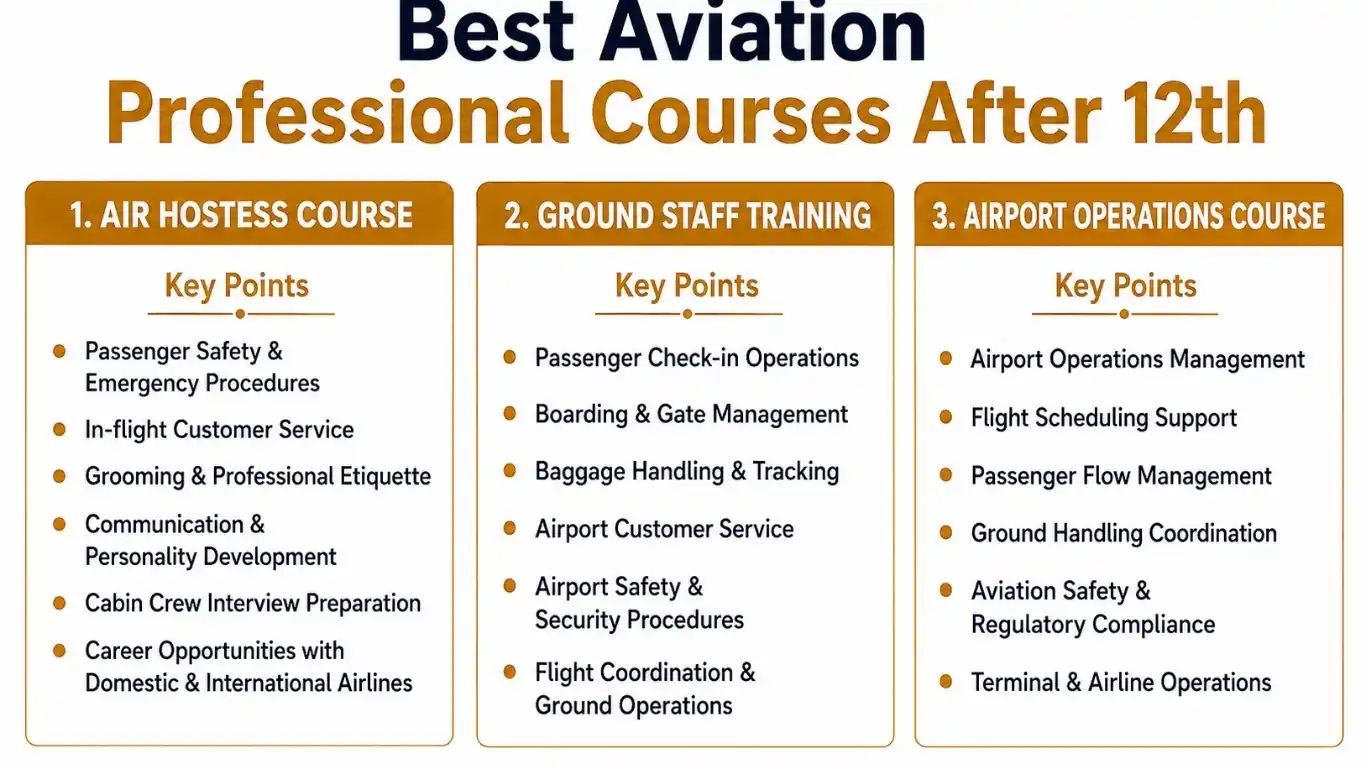
Students who have completed Class 12 can explore several aviation training options depending on the type of career they want to pursue.
Three common career-focused pathways include:
| Aviation Course | Best Suited For | Main Training Focus | Career Direction |
|---|---|---|---|
| Cabin Crew / Air Hostess | Students who enjoy communication and passenger interaction | Passenger service, safety, grooming and communication | Cabin Crew and passenger-facing airline roles |
| Flight Dispatch | Students interested in planning and aviation operations | Flight planning, weather, safety and operational coordination | Flight operations and dispatch-related roles |
| Airport Ground Handling | Students interested in airport operations and teamwork | Passenger handling, boarding, baggage and airport operations | Airport and airline ground operations |
There is no single aviation course that is best for every student.
The best aviation course in Chennai after 12th is the one that matches your skills, personality, interests and long-term career goal.
Which Aviation Course Is Right for You After 12th?
Understanding what each aviation course focuses on can make your decision much easier.
Diploma in Cabin Crew / Air Hostess
A Cabin Crew course can suit students who enjoy communicating with people, delivering customer service and working in a passenger-facing environment.
At Logica Training School, the Air Hostess / Cabin Crew program includes training in areas such as aviation fundamentals, passenger service, safety procedures, cabin crew operations, grooming, communication and interview preparation.
Key learning areas can include:
- Cabin crew duties
- Passenger handling
- Aviation safety
- Emergency procedures
- Customer service
- Communication skills
- Professional grooming
- Personality development
- Interview preparation
Cabin crew professionals are expected to communicate clearly, maintain professional behaviour, assist passengers and follow airline safety procedures.
Consider Cabin Crew training if:
- You enjoy interacting with people
- You are comfortable communicating with different passengers
- You are interested in customer service
- You want to improve your communication and presentation skills
- You are interested in a passenger-facing aviation career
Before enrolling, check the institute’s eligibility requirements, curriculum, practical training and career-support process.
Diploma in Flight Dispatch
Flight Dispatch Course can suit students who are more interested in aviation operations than passenger-facing roles.
Flight dispatch professionals support flight planning and coordinate with pilots and operational teams. The field involves understanding information related to routes, weather, aircraft operations and safety procedures.
Important training areas can include:
| Training Area | What Students Learn |
|---|---|
| Flight Planning | Routes, schedules and operational planning |
| Weather | Understanding weather information used in aviation |
| Aircraft Knowledge | Basic aircraft and performance concepts |
| Safety | Aviation safety procedures and operational guidelines |
| Communication | Coordination with aviation operations teams |
| Operations | Practical decision-making and operational awareness |
Consider Flight Dispatch if:
- You enjoy planning and coordination
- You are interested in airline operations
- You are comfortable analysing information
- You prefer procedure-based work
- You are interested in behind-the-scenes aviation operations
Students considering a Flight Dispatch course after 12th should carefully review the syllabus and understand how much practical operational training is included.
Diploma in Airport Ground Handling
Airport Ground Handling course can suit students who want to work within airport and airline ground operations.
Ground-handling professionals support many activities that take place before passengers board a flight and while aircraft are operating at an airport.
Depending on the role, ground staff may be involved in activities such as:
- Passenger check-in assistance
- Boarding support
- Passenger guidance
- Baggage coordination
- Customer service
- Communication with airport teams
- Supporting airline ground operations
- Following operational and safety procedures
For example, a ground-handling professional may help passengers complete check-in, guide them toward the correct boarding area or coordinate with teams handling baggage and passenger movement.
Consider Airport Ground Handling if:
- You enjoy working in an airport environment
- You like teamwork
- You are comfortable helping passengers
- You prefer active operational roles
- You are interested in airline and airport ground activities
Communication, coordination and attention to detail are important skills for students considering this career path.
How to Choose an Aviation Course After 12th
Choosing an aviation course should involve more than looking at the course name or selecting the program that appears most popular.
Before enrolling, evaluate the following areas.
1. Start With Your Career Goal
First ask yourself what type of work interests you.
If you enjoy meeting people and providing customer service, Cabin Crew training may suit you.
If you prefer aviation planning and operational coordination, explore Flight Dispatch.
If you want to work within airport operations and interact with passengers and airport teams, Airport Ground Handling may be more suitable.
Choosing based on your strengths gives you a clearer direction than selecting a course only because it is popular.
2. Check the Course Eligibility
Before applying for any aviation course, confirm whether you meet the eligibility requirements.
Many aviation training programs are available to students who have completed Class 12. However, requirements can vary depending on the course and institute.
Before applying, confirm:
- Class 12 qualification requirements
- Minimum age requirements, if applicable
- Communication requirements
- English proficiency requirements
- Course-specific eligibility
- Required documents
- Course duration
Always check the latest requirements directly with the training institute before enrolling.
Checking eligibility early prevents you from spending time considering a course that may not match your academic background or career plan.
3. Understand the Course Curriculum
The curriculum is one of the most important factors when comparing aviation courses in Chennai after 12th.
Do not choose a course only by looking at its title.
Ask the institute exactly what you will learn.
Depending on the aviation program, useful training areas may include:
- Aviation fundamentals and terminology
- Airport and airline operations
- Passenger handling
- Safety and emergency procedures
- Customer service
- Spoken English and communication
- Professional grooming
- Personality development
- Operational coordination
- Interview preparation
- Career guidance
Compare the curriculum of at least two or three institutes.
The syllabus should support the career you are planning to enter.
For example, students interested in Cabin Crew should look for training related to passenger service, safety, communication, grooming and interview preparation.
Students interested in airport operations should check whether the course provides relevant passenger-handling and operational training.
4. Look for Practical Aviation Training
Aviation is not a field where students should depend only on classroom theory.
Practical training helps students understand how to apply concepts in realistic workplace situations.
For example:
Cabin Crew students may practise:
- Passenger communication
- Customer service situations
- Safety procedures
- Grooming
- Interview scenarios
Airport Ground Handling students may practise:
- Passenger assistance
- Airport communication
- Boarding-related situations
- Team coordination
Flight Dispatch students may practise:
- Flight planning
- Operational coordination
- Understanding aviation information
- Decision-making activities
When comparing institutes, ask whether training includes practical activities, simulations, demonstrations, role plays, mock interviews or relevant industry exposure.
A balanced aviation program should combine theoretical knowledge with practical career preparation.
Why Practical Training Matters in Aviation
Classroom knowledge gives students an understanding of aviation concepts, procedures and terminology.
Practical training helps them use that knowledge.
For example, reading about passenger service can explain how a situation should be handled. A role-play allows the student to practise communicating with a passenger and responding to a problem.
Both forms of learning are important.
Classroom learning
Helps students understand:
- Aviation terminology
- Industry concepts
- Operational procedures
- Safety requirements
Practical training
Helps students develop:
- Communication
- Confidence
- Coordination
- Decision-making
- Professional behaviour
Role-play activities
Allow students to practise realistic passenger and workplace situations.
Team exercises
Help students improve cooperation and communication.
Safety activities
Help students understand why procedures must be followed correctly.
Students comparing aviation institutes should therefore look beyond classroom teaching and understand what practical exposure is included in the program.
Airport Visits and Industry Exposure
Industry exposure can help aviation students understand how concepts learned in the classroom relate to real airport environments.
During relevant airport visits or industry-exposure activities, students may observe areas such as:
- Passenger movement
- Check-in procedures
- Boarding processes
- Airport facilities
- Ground-handling activities
- Staff communication
- Passenger-service operations
- Professional workplace behaviour
For example, students interested in Cabin Crew or ground operations can observe how airport professionals communicate with passengers and coordinate activities during busy situations.
Logica Training School highlights airport visits and practical industry-focused training as part of its training approach.
Exposure like this can help students better understand workplace expectations before beginning their careers.
Mock Interviews and Career Preparation
Completing an aviation course is only one part of becoming career-ready.
Students also need to prepare for recruitment.
Mock interviews give students an opportunity to practise answering questions, improve their communication and understand how they present themselves during an interview.
Career preparation can include:
- Resume preparation
- Mock interviews
- Communication exercises
- Grooming guidance
- Personality development
- Industry-related questions
- Interview feedback
For example, a Cabin Crew student may practise answering:
“How would you handle an unhappy passenger?”
An Airport Ground Handling student might practise explaining how they would assist a passenger who needs help during boarding.
Regular practice allows students to improve their answers, confidence, body language and communication.
When comparing institutes, ask what structured interview and placement-preparation support is available.
What Skills Do You Need for an Aviation Career
Aviation training involves more than learning technical concepts.
Students should also develop workplace skills that help them communicate, coordinate and respond professionally in different situations.
Important aviation career skills include:
Communication Skills
Aviation professionals regularly communicate with passengers, colleagues, airport staff and airline teams.
Students should learn to:
- Speak clearly
- Listen carefully
- Use professional language
- Explain information simply
- Communicate calmly
- Maintain confident body language
For example, a Cabin Crew student may practise communicating safety instructions, while an Airport Ground Handling student may practise guiding passengers during boarding.
Strong communication skills can also help students perform more confidently during interviews.
Teamwork and Coordination
Aviation operations depend on multiple teams working together.
Cabin crew members, pilots, flight operations teams, ground staff and airport personnel may all need to coordinate information and responsibilities.
Students should learn how to:
- Follow instructions
- Share information
- Cooperate with team members
- Take responsibility
- Respond appropriately during busy situations
Practical group exercises can help students understand how teamwork operates in an aviation environment.
Customer Service
Passenger-facing aviation roles require patience, professionalism and the ability to understand customer needs.
Students should learn how to communicate politely, answer questions and respond calmly when a passenger faces a problem.
Customer-service skills are particularly important for Cabin Crew and passenger-handling roles.
Problem-Solving
Unexpected situations can occur in aviation and airport environments.
Students should develop the ability to understand a situation, communicate clearly and follow the correct procedure rather than react without considering the available information.
Practical scenarios and role plays can help develop this ability.
Professional Grooming and Behaviour
Professional presentation is important in many airline and airport roles.
Students may receive guidance related to:
- Personal presentation
- Professional etiquette
- Body language
- Workplace behaviour
- Interview appearance
Professionalism involves more than appearance. It also includes punctuality, communication, responsibility and behaviour.
Aviation Safety Awareness
Safety is a core part of aviation.
Students should understand the importance of:
- Following procedures
- Recognising potential risks
- Understanding emergency responses
- Following workplace safety guidelines
- Communicating safety information correctly
Cabin Crew students may practise passenger safety and emergency procedures.
Airport Ground Handling students may learn about operational safety requirements.
Flight operations students may understand how safety-related information supports planning and operational decisions.
How to Decide Which Aviation Course Is Right for You
Use this simple comparison before making your decision.
Choose Cabin Crew if:
- You enjoy meeting and communicating with people
- You are interested in customer service
- You prefer a passenger-facing career
- You want to develop communication, grooming and service skills
Choose Flight Dispatch if:
- You enjoy planning and coordination
- You are interested in aviation operations
- You prefer analytical or procedure-based work
- You are interested in supporting flight operations
Choose Airport Ground Handling if:
- You enjoy the airport environment
- You like working as part of a team
- You want to support passengers and airport operations
- You prefer an active operational career
Your decision should be based on what you enjoy doing and the type of aviation role you want to work toward.
Aviation Courses at Logica Training School
Students looking for aviation courses after 12th in Chennai can explore career-focused aviation programs at Logica Training School.
The available diploma pathways include:
Diploma in Air Hostess / Cabin Crew
Training focuses on areas such as passenger service, aviation safety, grooming, communication, cabin crew operations and interview preparation.
Diploma in Flight Dispatch
The program focuses on aviation operations, including flight planning, weather information, aircraft-related concepts, safety and operational coordination.
Diploma in Airport Ground Handling
Training focuses on airport ground operations, including passenger assistance, boarding support, communication, teamwork and operational procedures.
Students should discuss eligibility, curriculum, training methods and career goals with the institute before selecting a program.
Questions to Ask Before Joining an Aviation Institute
Before paying your course fee or completing admission, ask the institute:
- What are the eligibility requirements for this course?
- What subjects are covered?
- How much practical training is included?
- Are mock interviews conducted?
- Does the program include communication training?
- Are industry visits or exposure activities available?
- Who conducts the training?
- What career preparation is provided?
- What type of placement assistance is available?
- Which career roles does this course prepare students for?
Do not make your decision based only on advertisements.
Compare the actual training provided.
Conclusion
Choosing the right aviation course after 12th starts with understanding the kind of career you want.
Cabin Crew training can suit students interested in passenger interaction and customer service. Flight Dispatch can suit students interested in planning, coordination and aviation operations. Airport Ground Handling can suit students who prefer airport-based operational roles.
Before enrolling, compare:
- Eligibility
- Curriculum
- Practical training
- Industry exposure
- Trainer expertise
- Communication training
- Interview preparation
- Career and placement support
The best aviation course in Chennai is not simply the most popular course. It is the course that matches your interests, strengths and career direction.
If you are exploring aviation courses after 12th, review the available programs at Logica Training School and choose the pathway that fits your career goals.
Explore Aviation Courses at Logica Training School → Contact Us